Call for Papers: High-Consequence Viral Haemorrhagic Fevers in the WHO African Region: Readiness, Response and Recovery, 2021-2026
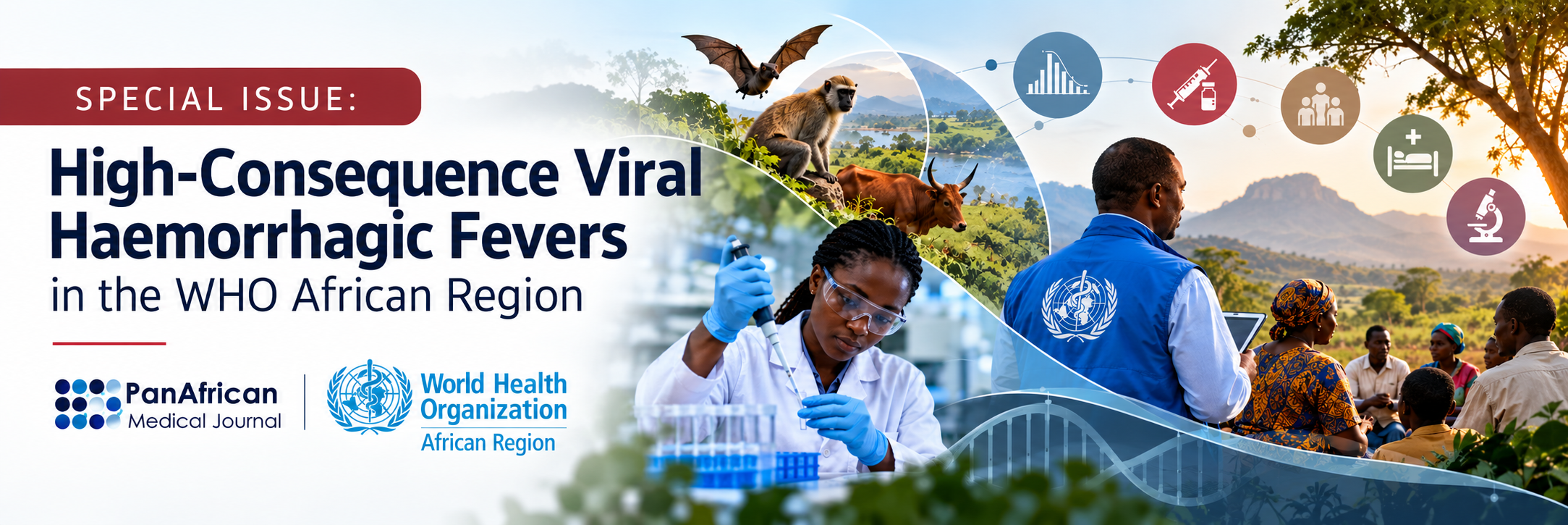
The Pan African Medical Journal (PAMJ), in collaboration with the WHO Regional Office for Africa (WHO AFRO), invites submissions for a special supplement in the PAMJ on High-Consequence Viral Haemorrhagic Fevers in the WHO African Region: Readiness, Response and Recovery, 2021–2026.
Recent outbreaks of viral haemorrhagic fevers across the WHO African Region have generated important epidemiological, clinical, laboratory, operational and social-science evidence. This supplement aims to bring this evidence together in a peer-reviewed collection, document lessons from recent outbreaks, and strengthen the evidence base for preparedness, response and recovery across the Region.
Scope of the supplement
The supplement welcomes disease-specific studies and cross-disease analyses addressing Ebola disease (including disease caused by Ebola, Sudan and Bundibugyo viruses), Marburg virus disease, Lassa fever, Crimean-Congo haemorrhagic fever (CCHF), and Rift Valley fever. Papers on earlier outbreaks, including the 2014–2016 West Africa Ebola epidemic, may also be considered where they provide relevant comparative or longitudinal insights. Yellow fever and dengue are outside the scope of this supplement.
Priority topics include:
-
Epidemiology, transmission dynamics and outbreak response performance;
-
Clinical presentation, case management, outcomes and survivor care;
-
Vaccines, therapeutics, clinical trials and countermeasure readiness;
-
Laboratory diagnostics, sequencing and genomic surveillance;
-
Infection prevention and control, including healthcare-associated infections and safe and dignified burials;
-
Risk communication, community engagement, trust and social-science evidence;
-
One Health, reservoirs, vectors, spillover ecology and environmental drivers; and
-
Emergency preparedness, coordination, financing, continuity of essential services, after-action reviews and recovery.
The supplement particularly encourages evidence and lessons from recent African outbreaks, including operational experience from frontline responders and affected countries.
Guest editors
- Dr Marie Roseline Darnycka Belizaire, Regional Emergency Director, WHO Regional Office for Africa (CONGO)
- Prof Patrick de Marie C Katoto, Scientific Adviser, World Health Organization Regional Office for Africa, Centre for Tropical Diseases and Global Health, Catholic University of Bukavu, Democratic Republic of the Congo Director, Centre for Equitable Immunisation and Pandemic Preparedness, South Africa (CONGO)
- Dr. Patrick Otim Ramadan, Emergency Preparedness and Response, WHO Regional Office for Africa (CONGO)
- Dr. Dick Chamdla, Emergency Preparedness and Response, WHO Regional Office for Africa (CONGO)
- Prof. Blondy Kayembe Mulumba, Emergency Preparedness and Response, WHO Regional Office for Africa (CONGO)
- Prof. Ebenezer Daniel, Emergency Preparedness and Response, WHO Regional Office for Africa (CONGO)
- Dr. Arisekola Jinadu, Emergency Preparedness and Response, WHO Regional Office for Africa (CONGO)
- Dr. John Otshudiema, Emergency Preparedness and Response, WHO Regional Office for Africa (CONGO)
- Dr. Anderson Ngattia Kouabenan, Emergency Preparedness and Response, WHO Regional Office for Africa (CONGO)
- Prof. Steve Ahuka-Mundeke, Incident Manager, DRC 17th Ebola Task Force; Institut National de Recherche Biomédicale, Kinshasa, Democratic Republic of the Congo (DEMOCRATIC REPUBLIC OF THE CONGO)
- Dr. Henry Kyobe, Incident Manager, Uganda Ebola Task Force (UGANDA)
- Prof. Justice Moses K. Aheto, Department of Biostatistics, School of Public Health, College of Health Sciences, University of Ghana, Legon, Accra (GHANA)
- Dr Raoul Kamadjeu, Health Emergency Preparedness and Response Team, UNICEF Centre for Excellence, Nairobi (KENYA)
Types of manuscripts accepted
Submissions may include:
| Original research articles | Reviews and systematic reviews | Short communications |
| Field and outbreak investigation reports | Commentaries and viewpoints | Case series and case reports |
| editorials | Letters to the editor |
All submitted manuscripts will undergo editorial assessment and peer review in accordance with PAMJ editorial procedures. Acceptance for the supplement is not guaranteed by submission. Submission can be in English or French.
Submission deadline and publication fees
Submissions are open now and will remain open until 15 November 2027.
Manuscripts accepted for publication in this supplement will be published immediately, free of charge. No article processing charges (APCs) will be charged to authors.
How to submit
Manuscripts must be submitted through the PAMJ Manuscript Submission System:
Submit your manuscript to PAMJ
During submission, authors must select:
Submission type: “Supplement - WHO AFRO VHF 2026 (Volume 1)”
Authors should ensure that their manuscript clearly falls within the scope of the supplement and complies with PAMJ manuscript preparation and submission requirements.

Pan African Medical Journal
This article is published by the editorial office of the PAMJ (KENYA)